Skip to content

Posts from the ‘snacks’ Category

the best way to eat a ripe tomato
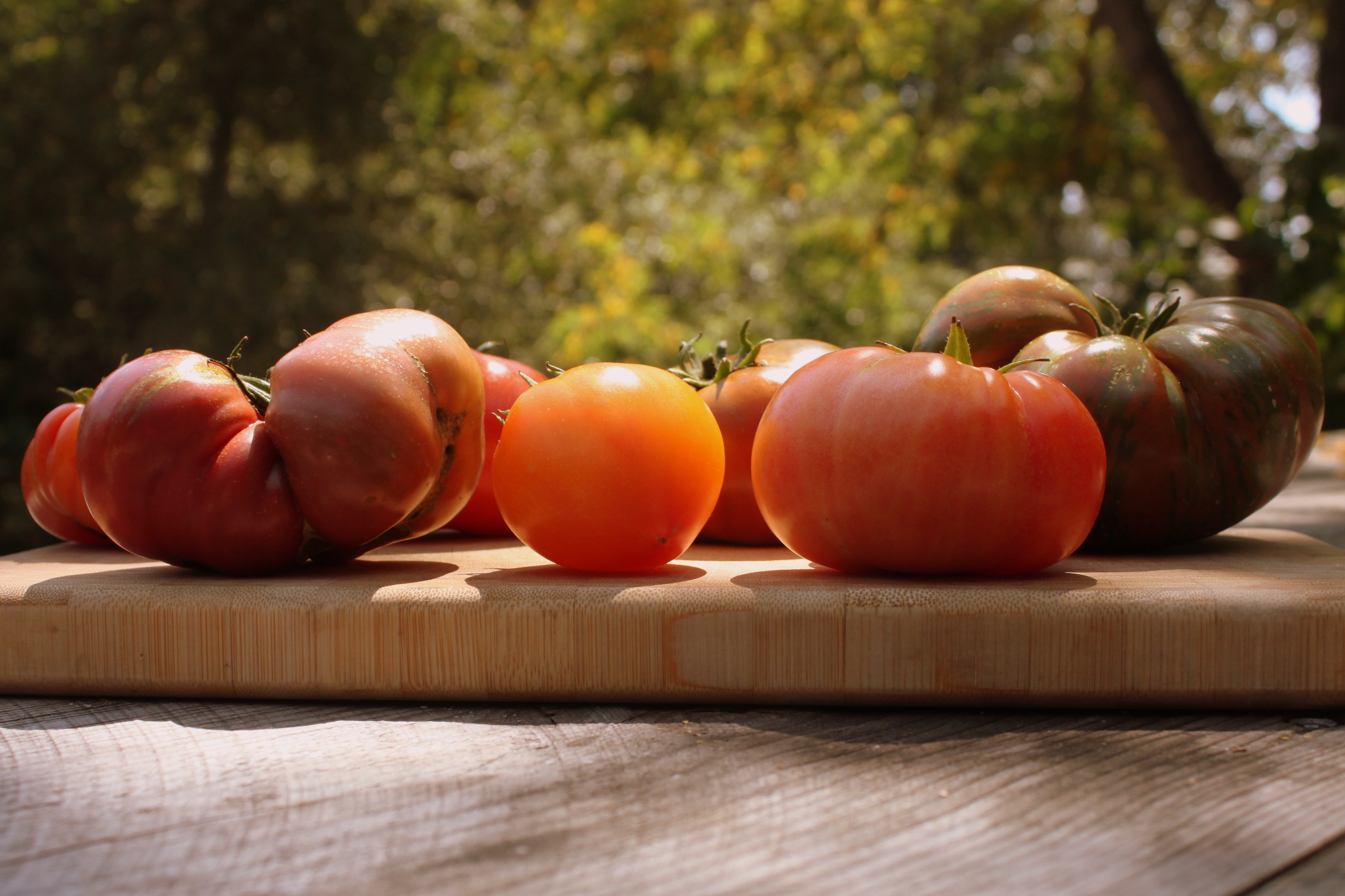
The season of the tomato has arrived.

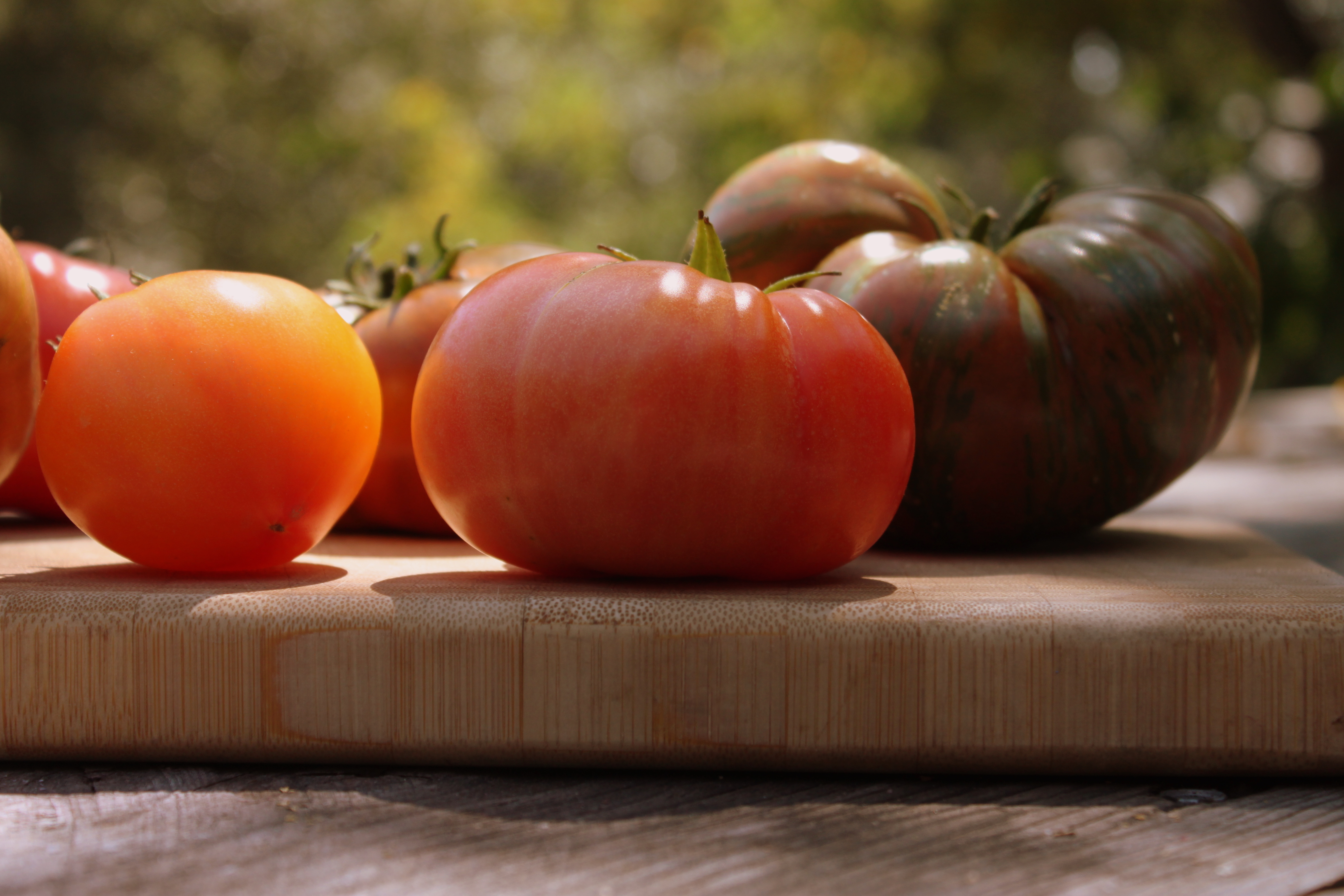
This season holds no small meaning for Love Apple, a farm named for the fruit I used to believe was red and round. This week, after a spell of perfect hot summer days, I lost that illusion for good—here tomatoes are orange, pink, black, gold, green and white, their shape long like a sausage or accommodating fantastic bulges. I always knew that tomatoes were Cynthia’s specialty, the cultivated passion that led the farm into the relationship it has with Manresa today. Now I finally understand: there are so many experiences a tomato can offer, and its season is the time to relish that variety.
With one season arriving, one has also drawn to a close. My friend and roommate Lisette left the farm this week, and as we all spent Saturday night drinking pitchers of IPA in downtown Santa Cruz we had our own little version of “farm dinner questions” to celebrate her time here. She asked us to remember a time we’d laughed with (or at) her, and the stories that came up were all of the “only on the farm…” variety, from dancing in the greenhouse on a winter’s morning to an episode I can only describe as involving zucchinis and a toilet. For my part, when I think of Lisette I remember the way she always greeted me with an enthusiastic “Miss B!” when we crossed paths in the garden. I’d never had a nickname from a friend before (“Sara” being somewhat lacking in wordplay potential), and it made me grin almost as much as I would when we’d sit in the kitchen after dinner giggling hysterically over Rowan Atkinson in Blackadder.

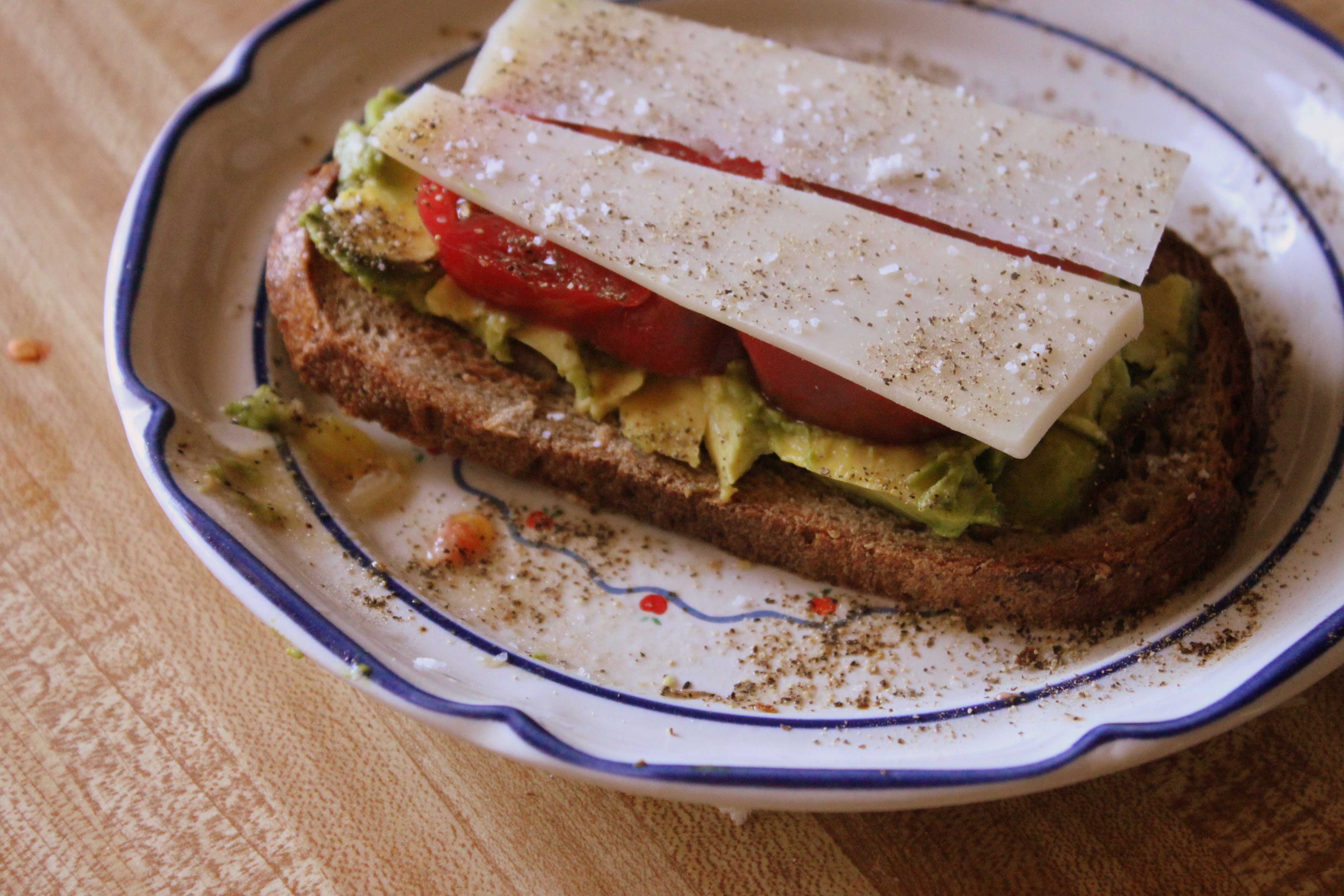
Lisette was the most knowledgeable among us apprentices when it came to the tomatoes on the farm, so it is in her honor that I want to share my favorite way of eating a ripe tomato. Nothing fussy, it’s something I’ve had every day this week for lunch. In fact I had to make it three times before I could photograph it today–not because it had to be perfect, but because I was hungry and found myself unable to resist a bite before I had the chance to get my camera.
The Best Way to Eat a Ripe Tomato

The key here is ingredients: ripe tomato, creamy avocado, good bread and a nice salty piece of cheese.

1 large ripe tomato

1/2 ripe avocado

slice of German wheat bread

1 or 2 slices of aged gouda or parmesan

salt & pepper

Toast your bread until crispy and golden, then layer with sliced avocado, thick slices of tomato, and cheese. Sprinkle with salt and pepper and enjoy!

best bran pancakes

I’m a bit of a morning person. Let me put it another way: the annoying family member clattering pans in the kitchen at 6:15? That’s me. The college suitemate looking unbearably perky from a jog as you staggered to the bathroom at 8 a.m. on a Monday? Me again. I know, morning people can be obnoxious.

The thing is, mornings are the only time I can really count on being in the kitchen alone. I can’t think of anything more satisfying than getting up early to sit at the kitchen table drinking tea, flipping through a magazine or reading the back of a cereal box. Getting up and going has never really been my thing, but leisurely mornings are like a gateway to the day, a cultivated pleasure. The water boiling, the stacks of articles to browse absently, the birds (or wild turkeys) chirping… I laugh at myself only because I take the ritual of mornings completely seriously.

And then there’s breakfast. I’ve trained myself to the point where skipping breakfast is physically impossible—not just because I might pass out at 11 a.m., but because my first waking thought is to wonder what I’m going to eat. For years I was a committed cereal devotee, pouring identical bowls of Grape Nuts, Wheatabix, or Shredded Wheat for months at a time (can you tell my parents never let me have Lucky Charms?). Here at the farm, however, the question of straight goat milk (in my case a no, or optimistically a “not yet”) pushed me to be much more creative with my breakfasts. I tried Irish oats with honey, toasted almonds, and raisins, and I did go through a phase of fresh goat cheese on toast with plum jam. Finally, though, I settled on pancakes. Having never made them from scratch (I fell for Bisquick when I ate 11 biscuity pancakes at a friend’s 9th birthday) I had lots of pantry-based experimenting to do—oats, flaxseed meal, bananas—but when I found a scrunched-up bag of wheat bran on one of our shelves I reached the end of my search. They were the perfect combination of fluffy and biscuity, and with some goat milk thrown in and a fried farm egg on top, I didn’t even feel too bad about leaving my cereal days behind.


Best Bran Pancakes

1/3 cup flour

1/2 cup wheat bran (I use Bob’s Red Mill, which is easy to find at most markets)

Pinch baking soda

Pinch salt

1 egg

1 scant Tbsp oil

½ cup milk

Mix the dry ingredients together in a bowl, then beat in the egg and oil. Add milk little by little to reach your desired thickness of batter—I like mine fairly thick, but play with the viscosity until you find your perfect amount. Heat oil in a skillet over medium high and spoon batter into the pan when hot—check for bubbling around the edges before you flip, and the rest you already know!

stas’ rainbow kimchi

I remember the very first time I saw Anastasia Van Wingerden. She was wearing a pale yellow dress and matching cardigan, both of which I instantly wanted. She had shoulder-length beach blond hair and a gap between her two front teeth, something I liked because I had a pronounced snaggle-tooth at the time. Best of all, she was smiling. It was my first day of fourth grade at a new school.

Thirteen years later she’s still my best friend and neighbor, and the one with whom I share many of my most vivid food memories. There was the time in junior high we tried improvising a smoothie in the blender, only to accidentally grind in the bottom half of a wooden spoon. There were the Amnesty International bake sales in high school, where she laughed at what I thought was superb donut salesmanship (“look at the sugar just oozing out of it!”). I’ll always remember her 19th birthday party, an event which featured a chocolate cake with an earthy  secret ingredient—beets. She was also the one who first got my family interested in keeping chickens, and I couldn’t help but think of the days of playing with “Stupy” and “Clinton Chick Chick” (he was quite the rooster) as I watched the turkeys her family breeds pecking about in their coop this weekend.

The Van Wingerden kitchen is one of those places I never want to leave, a haven of warm red tiles with handmade bowls of produce on every counter. I always make a beeline to “baked goods corner” (a spot my future kitchen will definitely have), then sneak bites of home-dried fruits or blistered almonds while munching my slice of chocolate chip cake or zucchini bread. I was, in fact, following that exact routine the other day when Stas showed me how to make kimchi, and in traditional Van Wingerden style there was a variety of veggies you generally only see on farms like the one I work on. Kale, carrots, zucchini, beets, green beans, onions, fennel… it all went into the pot, a cascade of color and texture that looked just as good a half hour later when it had been mixed by hand with salt and spices. I have a jar fermenting on my bureau, and when I taste it next week I know I’ll be back in that sunny kitchen with my friend, if only for a bite.

Stas’ Rainbow Kimchi

Kimchi may be an acquired taste, but if you like strong flavors it’s a delicious way to use and preserve vegetables. Not only do fermented foods aid digestion, but they are also full of probiotics that help build a strong immune system.

5 cups assorted vegetables

1/3 cup salt

spices (ginger, cumin, dill, juniper berries, celery seeds… the possibilities are endless!)

Chop your vegetables into small pieces and add them to a large pot or bowl (preferably ceramic, but not metal). Add the salt and use your hands to squeeze and press the veggies, gradually releasing their juices (the salt allows moisture to be more easily extracted). Add the spices and continue to work the vegetables by hand, squeezing until you have enough brine to cover them completely. This brine creates an anaerobic environment that prevents mold from entering, and you can add a little water if the juices from your veggies are not enough. Finish by using another, slightly smaller pot or bowl to press the veggie pieces down, keeping them submerged. Leave covered like this at room temperature to ferment for about a week, and put in the fridge only when you have achieved your desired flavor. (You can also put the kimchi into smaller containers like jars, turning and pressing down often to make sure the liquid continues to cover the pieces). If you like your kimchi less salty, give it a rinse before eating and enjoy!

chevre

I have a moldy wheel of cheese under my bed.

No, it’s not a long-forgotten midnight snack (although it wouldn’t be the first time). If all goes well, it will be the newest addition to my cheese-making arsenal: an aged, semi-hard Alpine cheese called a Tomme. Of course, by “if all goes well” I am referring to the problematic blossoms of gray-blue mold I found sprouting on my cheese yesterday when I pulled it out from underneath my bed/cheese cave. “Even if it’s covered in mold, in six months I’m still going to eat it,” I told a skeptical Ross and Zach as I scraped the offending rind. “I won’t pay your hospital bills” Ross muttered in reply.

Don’t be fooled—I haven’t turned into a cheese-making expert overnight. Though I proudly refer to the Tomme as “my cheese,” 90 percent of the work was actually done by our cheese-making instructor Fiona during the first ever Love Apple “Advanced Cheese-Making” class. I may not be able to mold and press my own hard cheese yet, but I’ve gotten very good at adopting leftover ingredients and demos from the cooking classes to play with on my own. In fact, just yesterday the Tomme was joined under the bed by a tray with eight cubes of Fiona’s feta that are about to be brined for four weeks.

Still, of all the things I’ve learned in Love Apple classes—from installing drip irrigation to brewing beer to making traditional French macarons—cheese-making is the thing I can see myself going on to do regularly. I’ve never been one to think of cooking as a science, but there’s something amazing about the fact that from the same four ingredients—milk, culture, rennet, and salt—can spring everything from a ricotta to a cheddar. It’s all in the process—making a chevre simply involves heating the milk and letting the culture do the rest, while most hard cheeses involve multiple preparatory steps and months of care. But what better way to spend a Monday morning than stirring a giant pot of warm milk and listening to New Order? With so many options I’m already looking forward to branching out–that is, if I can manage to prevent my Tomme from getting eaten alive by bacteria during the next six months.

Chevre

Making chevre is wonderfully easy when you have the ingredients: fresh milk and chevre culture (plus a good thermometer and cheesecloth) are really all you need. Certain brands of milk from the grocery store will work for cheese-making, and Fiona recommends looking for raw milk, or milk that has not been pasteurized and/or homogenized. That being said, finding a source of fresh goat milk can be challenging when you don’t live on a farm with goats (though you can order chevre culture from cheesemaking.com). Here is the basic recipe for making chevre at home if you want to give it a try!

1 gallon raw goat milk

1 packet chevre culture

salt

Make a water bath by filling a large pot 3/4 of the way with water and resting the pot your milk will go into inside (ideally the handles of the second pot will keep it suspended in the water). Add your milk to the second pot and warm to 86 degrees over medium heat, stirring occasionally and checking with a thermometer. When your milk reaches 86 degrees sprinkle the packet of chevre culture over the top, waiting two minutes for the culture to rehydrate. Stir for another minute or two, then set aside covered in a warm environment for 18-24 hours (we store the pot wrapped in towels).

At the end of the resting period, your curds should have risen to the top of the pot, floating in a disc on the whey. Using a perforated spoon, ladle the cheese into a cheesecloth-lined colander, then tie up the edges of the cheesecloth and hang for 4-6 hours (the longer the hang, the more crumbly the chevre). Take down your cheese and remove from the cheesecloth, stir in salt to taste, and enjoy!

garlic soup with sage and poached egg

I’m giving you advance warning: this is going to be another one of those “life philosophy” posts that I secretly planned on indulging in when I started this blog. One of the things I love most about working outside with my hands (ok, physical labor) is that it gives me ample time to let my mind wander, and as a former English major random acts of thinking are what I do best.

Of course there is such a thing as too much thinking. The times I’ve let my mind ramble a bit too freely I’ve either A) composed elaborately worded letters to boys who clearly didn’t like me anymore or B) come up with plotlines for truly original works of fiction (boy meets girl who tells him she’s a ghost come back to fall in love, but wait—she’s actually just delusional! Unfortunately I actually wrote that). Thinking is an art—no one wants to do a mental tally of the month’s finances, but take thirteen of an imagined conversation isn’t a good place to end up either (although that time, you really nailed the withering comeback). Overly pragmatic or dramatic thoughts keep you going in circles—reflection gets you somewhere much more interesting. Farming is work that gives you space to reflect, and that’s something I’ve discovered I really like.

Leaving home for New York my freshman year in college wasn’t the easiest thing, but I came out the other end having learned something that changed the way I looked at life. The lesson? Find the small things that consistently make you happy, then make sure they’re part of your life each day. It doesn’t matter whether I’m in the middle of Oklahoma city or the rolling hills of Virginia—if I can go for a nice run in the morning and spend a couple hour in the kitchen cooking at night, I’ll be that much happier. Dramatically happier. I know it sounds simple, but it works. There are dozens of things that can change how you feel, but when I’m sad or lonely I just run, cook, and do crossword puzzles more.

And now I think I’ve found something to add to the list: work that gives you room to think. It’s something that farming and cooking share, and for me, space to think is space to write. Someone I believe understands this very well is the chef and writer David Tanis, whose new NYTimes column City Kitchen I stumbled across the other day after reading an interview on Eater. Smitten I decided to try one of his recipes, and this simple garlic soup caught my eye. As a meal it was perfect—just a few key ingredients that come together to make something flavorful and rewarding.

A little bit like life.

Garlic Soup with Sage and Poached Egg

From David Tanis’ City Kitchen

8 cloves of garlic, roughly chopped

6 sage leaves, sliced into thin strips

3-4 cups water

salt and pepper

egg

toasted slice of good bread

In a medium saucepan, heat garlic and sage over medium-high heat for a minute or two. Add water before the garlic browns and simmer gently for 10 minutes to create a broth, seasoning with salt and pepper to taste. When your 10 minutes is up crack an egg in the broth to poach for two minutes. Lay your slice of toasted bread in a shallow bowl and ladle the egg on top, and finish by pouring in the broth.