Skip to content

nice n’ spicy bobotie (among other feasts)

Life on the farm is full of variety. One afternoon I might be tie-dying Love Apple t-shirts listening to reggae covers of the Beatles, the next wielding a machete through head-high thistles to a soundtrack of grunts and yells (it’s good to let the weeds know what’s coming). Yesterday I sowed purple mizuna and arugula in the greenhouse, lovingly covering the seeds with a thin blanket of soil; then I went out into the garden and killed 23 cucumber beetles, squeezing them mercilessly between finger and thumb. To quote one of my favorite movies, it’s the circle of life. (Not that the Lion King included tie-dye and machetes, but you get the idea).

Eating on the farm has been full of variety as well, and the last three nights have been a perfect example of that. Wednesday night we apprentices sat in the kitchen as we often do—hungry and surveying the pantry. What emerged was the kind of feast that happens when everyone around you likes to cook: fried eggplant slices from our master-fryer Phillip, sautéed purple carrots from Christine, a kale salad with basil and my honey mustard dressing, and a leek, chard, pepper and tomato vegetable bake topped with homemade goat cheese from our newest apprentice Ross. Everything came from the farm—excepting our mason jars of two-buck-chuck.

Thursday nights at Love Apple are Farm Dinner, a gathering of apprentices, farm staff, neighbors, and friends. Since Ross came to us from the New York Culinary Institute and several years of restaurant experience he was put on cooking duty, and the meal he came up with was memorable indeed: grilled tri-tip, roasted potatoes, Caesar salad and a collection of fixings for tacos. The entertainment of the evening is always a series of conversational games, and this week as we ate we mulled over what hat we would wear for the rest of our lives and, in the case of death by animal, which animal we would choose. (I went with “mauled by pit bull,” mostly for effect).

Friday night rolled around and I pulled out one of my favorite cooking tools: a “Nice n’ Spicy” packet of spices for the South African dish Bobotie. Coming from a family of South Africans it’s been a favorite of mine for years: ground meat spiced with curry, browned with onions, garlic, and ginger, and baked in the oven after being mixed with milk-soaked bread and eggs. As I carried it outside in the cast iron skillet with the turkeys gobbling in the distance and seven forks raised expectantly around the table, I remembered what I love most about cooking—it’s not just food we get to share, but meals.

Nice N’ Spicy Bobotie

Whenever any friends of my family visit South Africa there’s one request that tops the list: Nice N’ Spicy spice packets. Fortunately for us, with some good curry powder and nice bay leaves the bobotie packet is easy to replicate. For the non-red meat eaters in our group I used ground turkey and it turned out well, but ground beef or lamb is also delicious.

2 lbs ground turkey

2 slices soft bread

1 1/2 cups milk

2 Tbs curry powder

1 large onion, chopped

3 cloves garlic, minced

1 1-inch piece ginger, grated

1/2 cup raisins

1/2 cup slivered almonds

3 eggs

bay leaves

salt and pepper

Preheat your oven to 400 degrees. Soak the bread in the milk until soft, then strain and reserve leftover milk. Gently mix the bread with the ground meat and curry powder.

In a heavy-bottomed skillet or pot, saute the onions, garlic, and ginger in olive oil or butter until translucent. Add the meat mixture and stir until the meat is nicely browned, then add in the raisins, almonds, half of the reserved milk and one egg. Season with salt and pepper.

Even out the meat in the skillet until you have a flat surface, then beat the remaining 2 eggs with the other half of the reserved milk and pour over the top of the bobotie. Arrange several bay leaves over the top and bake in the oven until the egg mixture on top is well browned, about 30-40 minutes.

spiced tomato eggplant stew

It was 12:24pm. I was watering the hillside when Cynthia approached from across the garden, leading a visitor on a tour of the farm. “Give it three more minutes,” she called up to me, “You need some lunch.” Five minutes later, hose coiled, I was sprinting up the hill to the cottage with the kind of ravenous look one generally associates with lost backpackers emerging from the woods (or maybe seagulls).

As a farm apprentice you don’t feel like lunch, you don’t even want it—you need it. Sometime after noon the seven of us converge on the cottage kitchen, grabbing food from the fridge and unceremoniously clattering plates and cutlery in our haste. Leftovers are the golden ticket—a quick spin in the microwave and you’re through your first three bites before you’ve even taken a breath.

My history with leftovers is rich and varied, beginning with classmates’ wrinkled noses when I opened my Tupperware at school and carrying all the way through college, when I cooked Fridays and Mondays and ate my curries and soups with relish for three days straight. I’ve always been of the opinion that the worse leftovers look the better they taste, and it’s only a handful of times (notably the week-old burrito incident) that my theory has proved wrong. Today, however, I can proudly declare my leftovers have entered a new chapter. Gorging on cold eggplant stew was a sort of food heaven, the kind where every bite restores mental and physical acuity. Full disclosure: I plotted my lunch escape five minutes early. When cold stew’s involved, I take no chances.

Spiced Tomato Eggplant Stew

Adapted from Ancient Grains for Modern Meals by Maria Speck

1 onion, chopped

2 cloves garlic, minced

2 medium eggplants, diced

½ cup carrots, chopped

2 teaspoons cinnamon

½ teaspoon cloves

1 28-oz can of tomatoes

2 cups chicken broth

1 cup farro

½ cup sultana raisins

1 teaspoon hot sauce

1 teaspoon sugar

Salt and pepper

Sauté the onion and garlic in olive oil over medium heat. Add the eggplant, carrots, cinnamon and cloves, stirring occasionally until the veggies begin to soften. Add the tomatoes, broth, sultanas and farro, bringing to a boil before decreasing heat and simmering until the farro is cooked and the carrots are tender (depending on how thick you would like the stew to be you may need to add additional chicken broth or water). Season to your liking with hot sauce, sugar, salt and pepper, and enjoy warm (or cold the following day).

irish oats with fried egg and salt

I’ve been on the farm for a week now, and there have been many exciting developments. I sowed my first seeds. I learned how to make vanilla apricot jam. I woke up to see a mouse clinging to the wall above my bed. And then, perhaps most exciting of all, at our weekly farm apprentices’ meeting I was designated chicken foreman.

Before you get too congratulatory, let me be clear: this wasn’t really a job anyone wanted. There are 62 chickens on the farm, and since we take turns collecting the eggs every afternoon the responsibilities of chicken foreman are generally limited to coercing someone into closing the coop after dark. Clambering blindly up the pasture at night where 62 chickens romp (and poop, prolifically) by day is not particularly fun, and when you reach the coop there is only a downhill slide (through the poop) to look forward to. Being a proponent of conflict avoidance by nature, I anticipate many dark nights of coop closing.

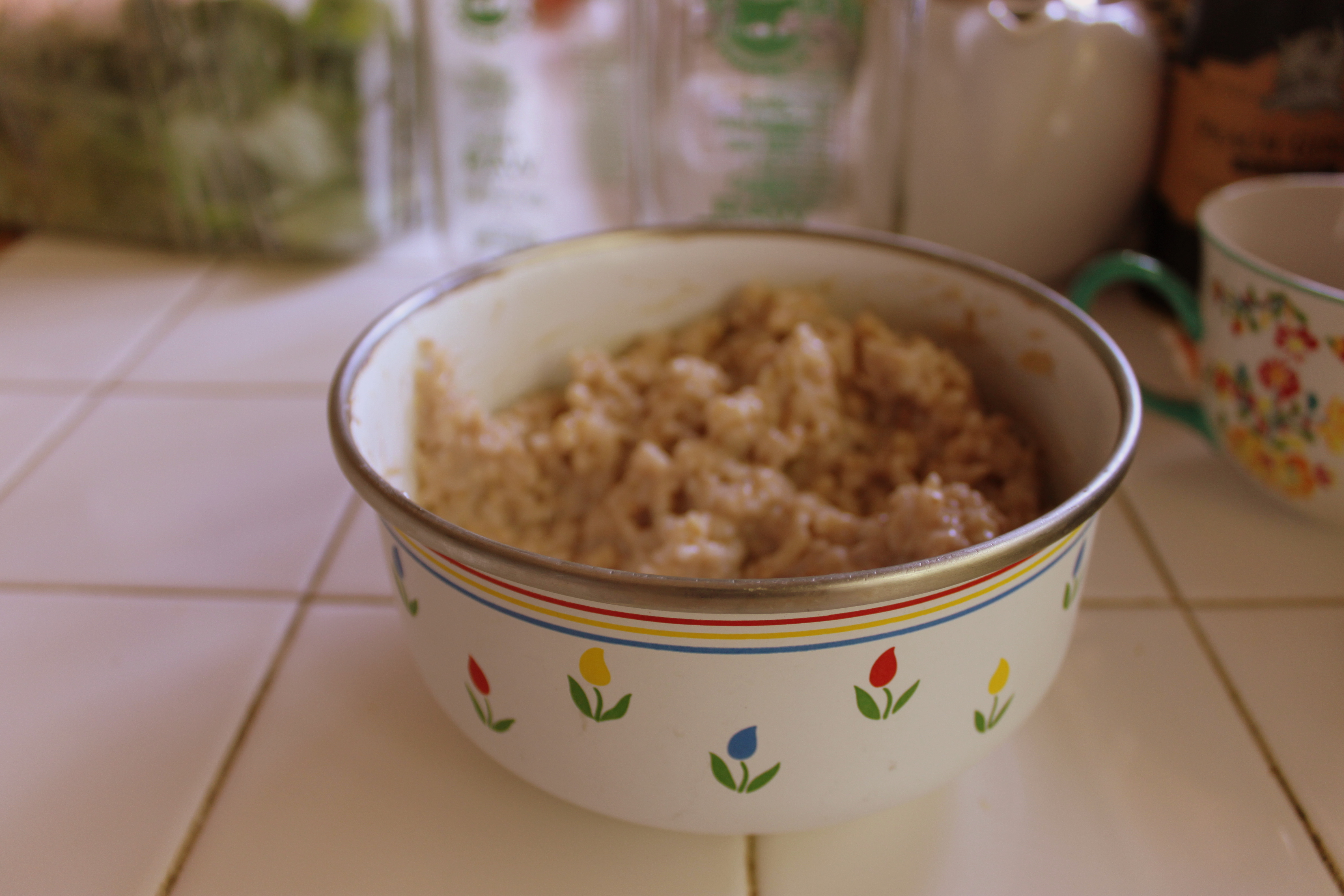
On the bright side, 62 chickens means 55 eggs a day, and if there’s one thing I never tire of eating it’s eggs. More specifically, fried eggs. Over the years I’ve come up with various ways to enjoy them–on toast spread with avocado, with pasta, alongside sautéed chard—but my absolute favorite invention is a fried egg on Irish oats. (As of now I’m still fairly certain it’s my invention, if only because everyone I tell about it recoils with what I interpret as skepticism). As simple as it is there’s something wonderfully satisfying about stirring the whole mess together, a perfect mix of hearty oats, creamy yolk, and crispy fried edges. I could eat it every day, and as chicken foreman I just might.

Irish Oats with Fried Egg and Salt

As with many things I enjoy, the key to making this delicious is salt. I like to sprinkle it over the egg while it’s frying, and I usually add a little extra when it’s all mixed together.

1/2 cup Irish oats

1 egg

olive oil

salt

Bring 1 1/2 cups water to a boil and stir in the oats. Return to boiling before lowering the heat and simmering uncovered for about 10-15 minutes. While the oats are cooking add a generous amount of olive oil to a small pan and fry your egg, turning off the heat when the yolk is still runny but the edges have crisped nicely. When the oatmeal is thick and done pour it into a bowl. Top with your egg, sprinkle with salt, and mash everything together. You should end up with a bowl of creamy-looking oats flecked with bits of crispy egg.

coconut rice pudding with cinnamon

Flipping through a food magazine in the kitchen last night I had a moment of self-discovery, handily delivered by a nifty magazine sidebar fact: “A new study shows there’s a genetic enzyme in saliva that makes some people more prone to craving soft-serve ice cream, pudding and other foods with similar textures.” Frozen yogurt? Definitely a fan. But what leads me to believe my textural cravings might be genetic is my unfailing love of rice pudding.

My family has always been skewed firmly towards the rice end of the rice/potatoes continuum. My grandparents’ table is never without a lidded glass dish of brown basmati, and after my parents received a Persian rice cooker 10 years ago a giant rice dome tinted yellow with saffron has graced the table at almost all our dinner parties. I personally encountered rice nirvana rather late in life, when I discovered sticky coconut rice at a Thai food joint on Amsterdam Avenue my sophomore year. The fact that I got serious food poisoning from the place and went on to make my version of coconut rice pudding every night for months is a testament to my love (and obsessive food tendencies).

Maybe it was the lone can of coconut milk on the dusty top shelf of our communal kitchen. Maybe it was the nine jars of goats’ milk filling the upper level of our fridge. Either way the end result was that a few nights ago I fired up the electric stove for a hybrid goats’ milk/coconut rice pudding, stirred lovingly for almost an hour and plied liberally with honey, cinnamon, and salt. We enjoyed it warm after a hearty dinner of chard and eggs (two other farm staples hogging the fridge), but I liked it even better the next day when, starving from a four-hour battle with waist-high foxtail weeds, I ate it straight from the refrigerated pan with the certainty that my DNA fully justified my behavior.

Coconut Rice Pudding with Cinnamon

The key to good coconut rice? Salt. A good rice pudding? Cinnamon. Use lots of both and the effect is magical. Also I tend to go with brown rice for a slightly healthier version, but whether you use brown or white keep in mind that shorter grains make for a stickier end result.

1 1/2 cups rice

1 oz can coconut milk

1 cup milk

1 Tbsp honey

cinnamon

salt

In a medium-sized saucepan, heat 2 1/2 cups of water with a 1/2 cup coconut milk. Cook your rice as directed, and when it’s barely done add the rest of the coconut milk and stir until thick and creamy. Add the milk in two or three doses, waiting each time until the liquid is fully absorbed and stirring regularly to prevent the bottom from sticking. Add the honey and taste for sweetness. Lastly season generously with cinnamon and salt before removing the saucepan from heat to cool and settle before serving (or diving in with a spoon).

clafoutis (and welcome!)

Day one at the farm, and I’m standing in the empty kitchen where three hours earlier I watched Chef Kinch flip a perfect French omelet for 16 eager cooking class attendees. On my left Pim pulled a clafoutis from the oven, testing it with her finger for the desired spring of the top and, satisfied, whisking it onto the counter. As a class assistant I didn’t have long to watch—the mixing bowls were piling up—and it is with fingertips wrinkled from dish-washing that I write this post to welcome you to a journal of my time here learning, cooking, and eating at Love Apple Farm.

It’s now day three, and one afternoon of compost making, two clafoutis, and three goat milkings later the welcome I started to write two nights ago is finally ready to post. Last week I folded my J. Crew pencil skirts for storage and searched out the biggest sunhat I could find (the kind with an oh-so-attractive drawstring under the chin) and now I’m finally here, working as a farm apprentice. My duties range from watering seedlings with worm tea (don’t ask) to assisting in cooking classes with Manresa chef David Kinch and Pim of the lovely blog Chez Pim, and from the soil to the harvested leeks I’ll turn into potato leek soup tonight, it’s all about the journey from farm to food.

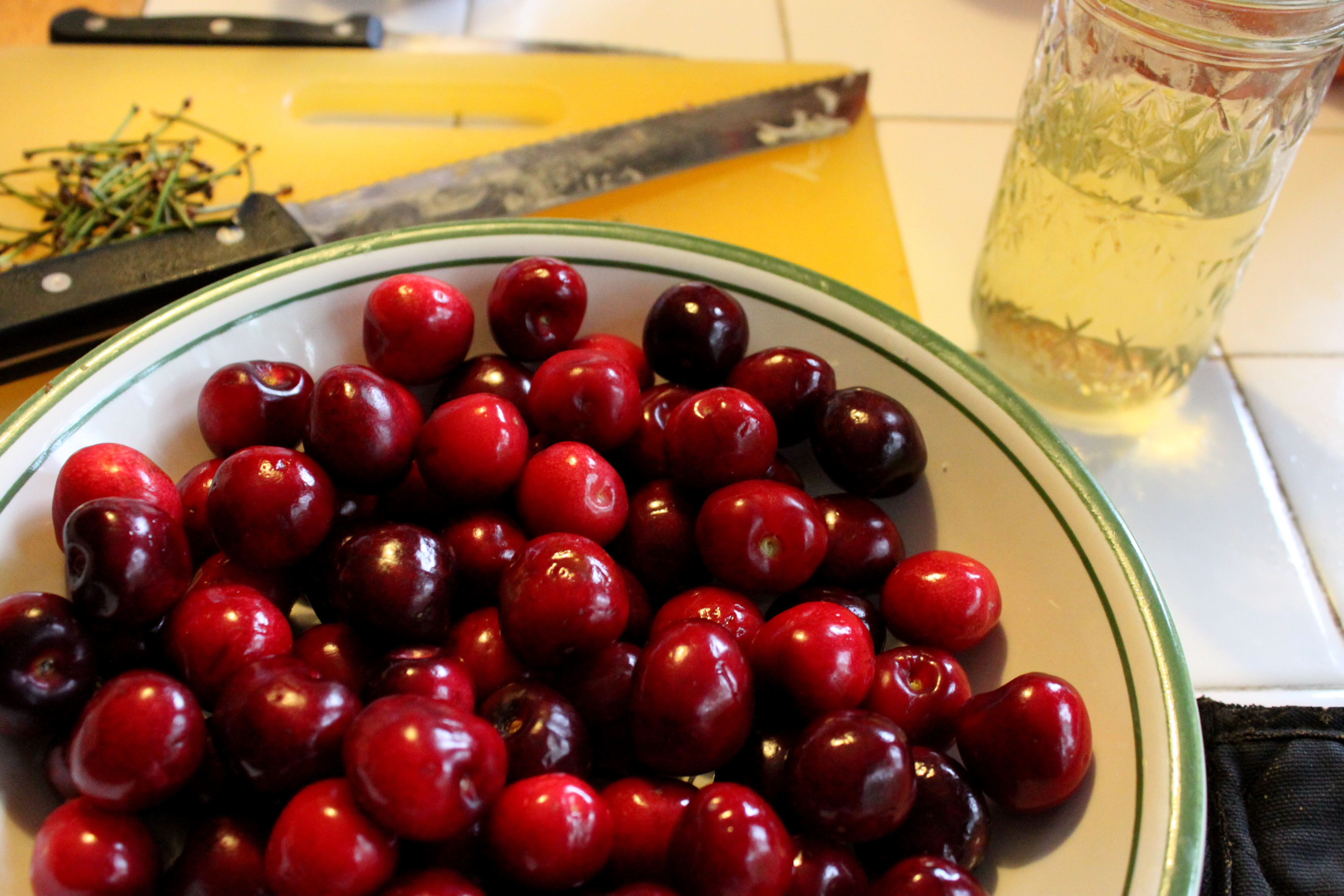
The clafoutis Pim made was a traditional clafoutis, which is always made with cherries—“Saying ‘cherry clafoutis’ is like saying ‘egg omelet!’” she reminded us cheerfully during class. I don’t have my own recipe just yet, but I do have a new fondness for the dessert, not only because it is light and delicious, but because it became something of a symbol of my first day. There was the clafoutis made for the students, of which I enjoyed a few quick bites while washing up. But hours later there was another one: baked in our apprentices’ cottage kitchen, doctored with fresh goat’s milk, and placed on a kitchen table laden with lemon bars, a buttery onion tart, and a batch of homemade fried chicken and gravy. I felt entirely at home, and as we ate our dessert warm from the oven I’d already forgotten it was only my first day.